Research Publications, Authorship, and Funding Transparency
NIH Authorship Requirements & the Stevens Amendment
The Office of Research Compliance & Regulatory Affairs (RCRA) provides guidance to help researchers, faculty, communications professionals, and administrators navigate federal requirements related to publication transparency, authorship, affiliations, collaborations, and funding disclosures. Recent national discussions have highlighted the importance of coordinating research integrity, research security, and communications efforts to ensure accurate representation of federally funded research.
Why It Matters
Both NIH authorship expectations and the Stevens Amendment promote transparency by ensuring that:
- Authors and affiliations are accurately represented.
- Funding sources are appropriately acknowledged.
- Research collaborations are transparently disclosed.
- Public-facing communications align with published research.
NIH Authorship & Publication Considerations
Click the image for the full quick reference infographic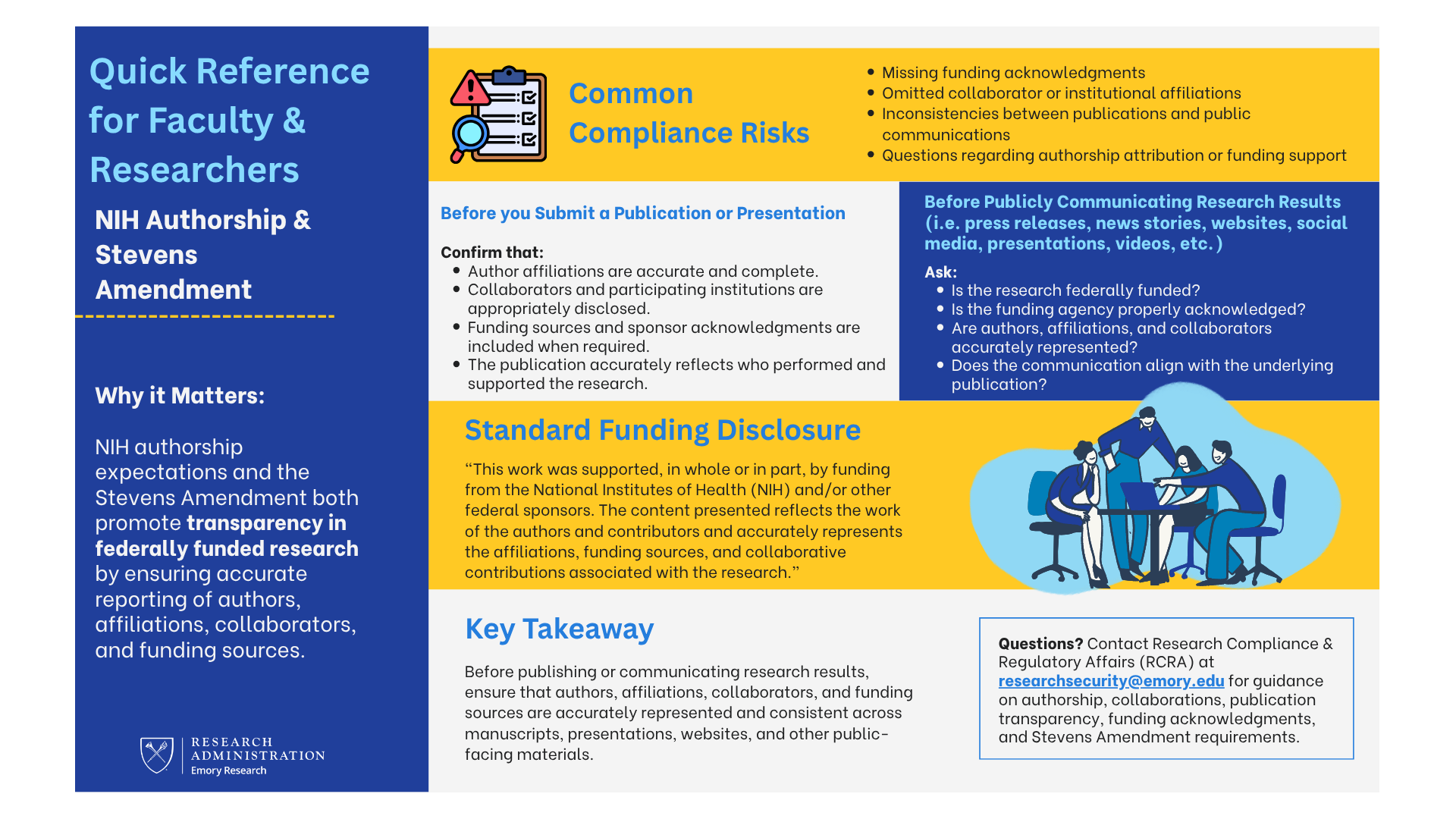
Before publishing or communicating research results, researchers should ensure:
✓ Author affiliations are complete and accurate
✓ Collaborators and participating institutions are appropriately represented
✓ Funding acknowledgments are included when required
✓ Publication information accurately reflects the research conducted
Stevens Amendment Considerations
The Stevens Amendment requires disclosure of federal funding support in certain public-facing communications involving federally funded activities.
Examples may include:
- Press releases
- Research news stories
- Websites highlighting federally funded projects
- Social media posts referencing sponsored activities
- Event materials
- Videos and promotional content
- Program announcements
For shorter communications where the full disclosure or author/collaborator list is not feasible (ex. social media posts or general articles that briefly reference several studies), include a link/reference to the publication or press release where the required disclosure can be found.
For Communications Teams
Click the image for the full quick reference infographic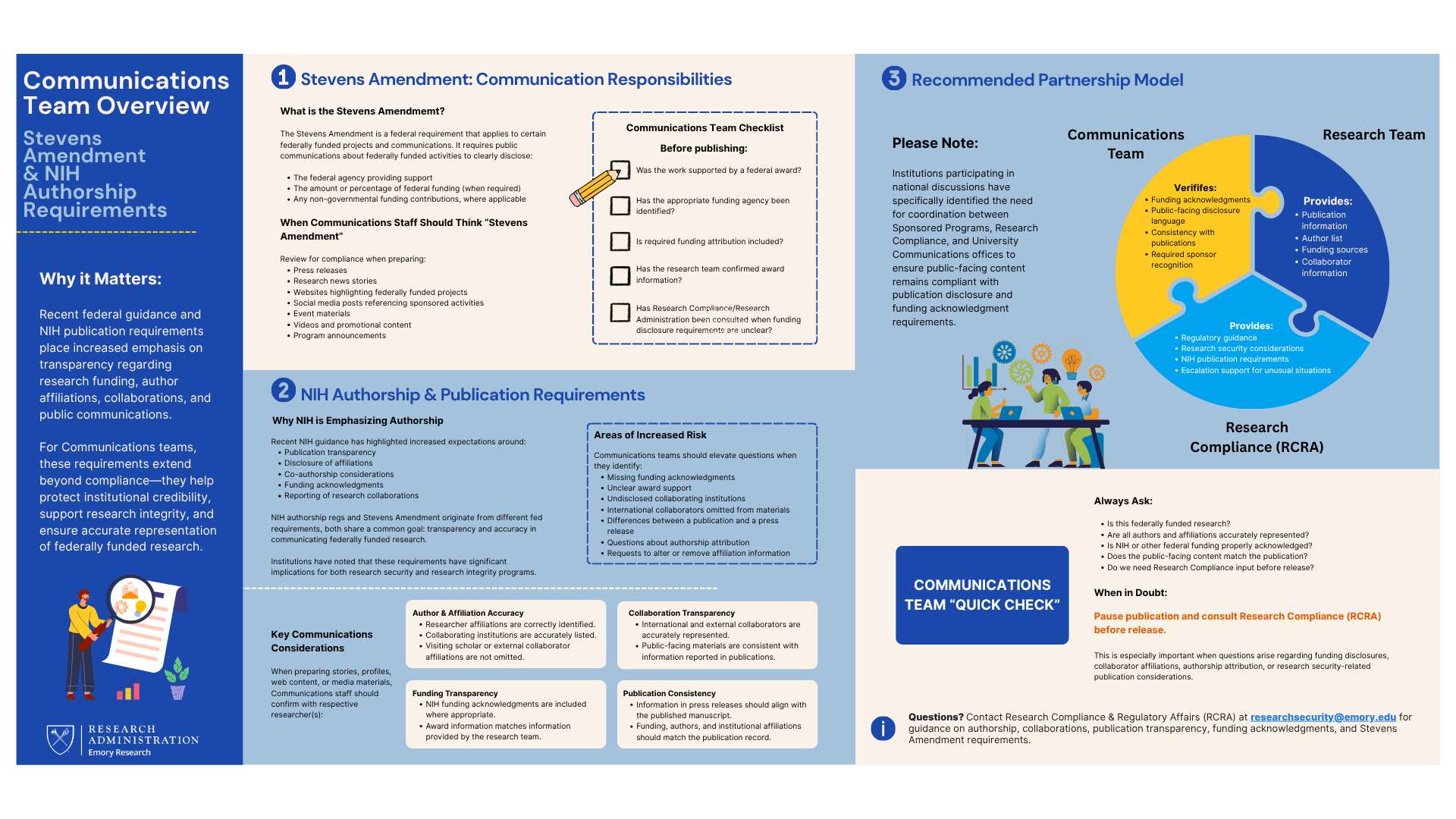
Before Publishing:
✓ Was the work supported by a federal award?
✓ Has the appropriate funding agency been identified?
✓ Is required funding attribution included?
✓ Has the research team confirmed award information?
✓ Has Research Compliance/Research Administration been consulted when funding disclosure requirements are unclear?
Standard Disclosure Statements
Funding Disclosure(Researchers):
This work was supported, in whole or in part, by funding from the National Institutes of Health (NIH) and/or other federal sponsors. The content presented reflects the work of the authors and contributors and is intended to accurately represent the affiliations, funding sources, and collaborative contributions associated with the research. All applicable sponsor acknowledgment and disclosure requirements have been followed.
- For NIH funded research (NOT-OD-26-084): Recipients are required to state (1) the percentage and dollar amounts of the total program or project costs financed with Federal money and (2) for NIH programs requiring cost sharing, the dollar amount of the total costs financed by non-governmental sources (i.e., percentage and dollar amount of support from federal and non-federal sources). In general, NIH programs do not have a legislative requirement for cost-saving. Any cost-sharing requirements will be outlined in the NOFO.
Research Funding and Authorship Disclosure(Communications Teams):
This research was supported by federal funding through the National Institutes of Health (NIH) and/or other sponsoring agencies. Author affiliations, collaborator contributions, and funding acknowledgments have been reviewed to promote transparency and compliance with applicable sponsor requirements, including publication and public communication disclosure obligations.
Frequently Asked Questions
"Research reported in this [publication/press release] was supported by [name of the Institute(s), Center, or other NIH offices] of the National Institutes of Health under award number [specific NIH grant number(s) in this format: R01GM987654]."
Please note: If you have more than one grant, only cite the grant(s) that supported the research described in the article or presentation.
View the NIH's full guidance on communicating and ackowledging federal funding on their webpage.
Additional Resources
- NOT-OD-26-084
- NIH - Communicating and Acknowledging Federal Funding
- COGR - Foreign Component Discussion
- FDP RS Subcommittee: NIH Extramural Leadership Discussion - Co-authorship and Foreign Components FAQs
NSF Secure Center - Authorship Toolbox
These downloadable resources were developed to support navigating compliance with federal authorship guidlines.
- Authorship Checklist - Guide for manuscript submissions, publication reviews, routine research security monitoring, and/or sponsor inquiries.
- Authorship Fact Sheet - Authorship research security & risk awareness
- Authorship Quick Reference Guide - Outlines where authorship-related information should be disclosed to ensure consistency across journals, sponsors, and institutional systems.
Questions regarding publications, authorship, collaborations, or funding disclosures may be directed to the Research Compliance & Regulatory Affairs (RCRA) at researchsecurity@emory.edu for assistance.